The Library Instruction Cookbook
Collects ideas for interactive information literacy lessons.
Collects ideas for interactive information literacy lessons.
Roadmap specifically for librarians who are new to instruction, or who are charged with training someone who is new. Includes sample lesson plans and activities, observation form, training checklist, etc.
Strategies to guide students towards meeting instructors' expectations for critical thinking. Includes sections on active learning, assessment, and the ACRL Framework.
Practical, ready-to-use activities from Professor of Communication Constance Staley.
Combines theory with specific lesson plans and assessment options related to ACRL's threshold concepts.
During this activity, students work in small groups to explore assigned databases and then share back what they learn in a Google Doc projected at the front of the classroom.
Disciplinary Applications of Information Literacy Threshold Concepts provides a balance of theoretical and practical to help readers both conceptually and pragmatically with their work in supporting student learning, including chapters in which librarians have designed learning outcomes aligned with the frames of the Framework.
This activity/assignment was designed for a first year composition course in collaboration with an English/Writing instructor. It could be used in an information literacy credit course, First Year Experience course, or in another discipline-specific context. The purpose of the lesson is to lay the foundation for students to be able to read scholarly work more effectively and critically.
OER Commons offers a comprehensive infrastructure for curriculum experts and instructors at all levels to identify high-quality OER and collaborate around their adaptation, evaluation, and use to address the needs of teachers and learners. Searchable by keyword, subject, and material type, including activity, assessment, lesson, and teaching/learning strategy.
This interactive learning module takes students through the process of identifying the differences between primary and secondary sources. The structure of the tutorial consists of four parts. First, students learn the definitions for both primary and secondary sources. Next, the students work through various examples of primary and secondary sources in different academic disciplines at their own pace. In the third part, common mistakes are addressed in “Mythbusters” style.
Communication Teacher is a peer-reviewed publication of the National Communication Association. Communication Teacher publishes original scholarship that considers the practice and assessment of the teaching of communication across K-2, university/college, and other educational contexts. Includes activities that can be implemented in any communication course, across single classes or units.
We recently added 20 new resources to the Teaching Toolkit section of CORA! In need of new information literacy activity ideas this semester?
Two dozen teachers, librarians, administrators, and writing center professionals share their expertise and insights on successfully utilizing the frameworks for writing and information literacy.
A place to discover ways to use the Framework for Information Literacy for Higher Education in instructional settings, as well as share your own activities and teaching resources related to the Framework. Resources include activities, assessment, assignments, bibliographies, blog posts, learning objects, and practitioner reflections. Results can be filtered by discipline, information literacy frame, institution type, license, and scope.
Explores issues of the theory and practice of inclusive and reflective teaching in order to broaden students' understanding of power structures within the education system and in society.

I presented on CORA at the 2016 Library Assessment Conference in Arlington, VA. Recurring themes at the conference included
A white paper published by the Association of College & Research Libraries. Written by a working group of leaders from many parts of the association, this white paper explores and articulates three intersections between scholarly communication and information literacy. The paper also provides strategies for librarians from different backgrounds to initiate collaborations within their own campus environments between information literacy and scholarly communication.
This group activity can be used in a variety of disciplines and contexts. Pass the Problem aims to have students provide feedback to other students on database and keyword selection. By having students critique each other it works to build critical self-reflection during the research process (it's also pretty fun!).
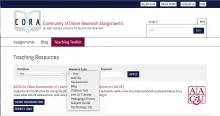
CORA tweaked its homepage last week and revamped the Teaching Resources section. The section was rebranded “Teaching Toolkit” to reflect an expanded list of resource types.